It is the most influential book in the the Western World and the best selling book in all of human history. For thousands of years, people have killed for what is written on its pages. Wars have been fought and societies have risen and fallen because of its teachings. Even today, world leaders pay homage to it whether they believe it or not. Roughly a third of the world's population, more than 2 billion people, consider themselves adherents of this book. It is, of course, the Bible and it is the subject of a new History Channel mini-series.( http://www.history.com/shows/the-bible)
To say it is a monumental task to capture this book in a mini-series is like saying that Jaws was a fish and the moon is just a rock. The Bible is so full of stories, life-lessons, history and prophecy that it can't ever be fully captured by a television production, no matter how great the budget. When you add to this the fact that its stories are so well-known and its text is so revered, it would seem like a Mission Impossible assignment for any filmmaker to receive. To tighten the noose around the filmmakers' necks even more, we need to remember that in our politically correct world it is not prudent to talk too much about God or to ever get too religious...especially if you want to appeal to a broad audience, as is the case with television.
Well...now that the parameters have been set and we know what the creators of the mini-series are up against, how did they fare? As of this writing, only one episode of The Bible mini-series has aired. The story starts with Noah on the Ark recounting the creation story as it is told in Genesis and it progresses through the stories of Abraham and Moses. Episode one concludes with Joshua taking the city of Jericho. For a two hour show that is interrupted by commercials, the first installment in the series covers quite a bit of territory. Of course, it glosses over a lot. It also expects the viewer to be familiar with the material...for example, a rainbow is shown during the Flood sequence, but it is never explained to be God's promise not to bring another flood. As I watched this, I couldn't help but wonder if someone who didn't know the stories would have understood these touches.
The Bible mini-series also had other more theological subtleties that I'm not sure many viewers would get...like when Abraham was talking to God and the figure of God was Jesus, who we will see in a future episode. Theologically speaking, the series creators were of course saying that Jesus and God are one and the same and they have always been so, but will the average viewer catch that? I don't know.
At this point, I can't render a verdict on the entire series because I've only seen one episode. But I can say that I am duly impressed by the scope and quality of the production. I am also respectful of the task the filmmakers have before them and appreciative of their faithfulness to the spirit of the text. Lastly, I am thankful that they chose to take this on. Every generation should have a television or motion picture collection of Biblical epics to call their own. In my estimation, its an important guidepost for our society. Hopefully, its ratings will be good enough to make other Hollywood filmmakers sit up and take notice. To quote Cecil B. DeMille's most famous work, "So let it be written, so it shall be done."
Tuesday, March 5, 2013

Monday, February 25, 2013
ARGO, LINCOLN, DJANGO...fiction is big bucks!
Like a billion other people, I watched last night's Oscar telecast. Unlike a majority of the viewers, however, I had no interest in what the actresses were wearing. I was only mildly interested in Seth MacFarlane's hosting abilities. Some of the songs impressed me, particularly Adele's Skyfall. But the main reason I watched the show was to see which "historical" movie won Best Picture. I put quotation marks around the word historical because none of these films were completely accurate and some of them were totally fictionalized.
Argo, of course, won and as a result, the web was set ablaze with comentary on the movie and interviews with people involved in the real hostage rescue that was portrayed in the film. The most attention grabbing interview was with the Canadian ambassador who was depicted in the film. His greatest complaint was that his role was downplayed. I've read other interviews with people who thought the movie added too much fiction...most notably a chase at the end of the film that never took place in real life. And as one might expect, the Iranian government was all up at arms about the movie, claiming it was a US government sponsored PR film to promote the CIA.
Django Unchained was undoubtably a work of fiction. Just like Quentin Tarantino's Inglorious Basterds, Django was a fantasy in which some of history's greatest villains (in this case, slave owners) were slaughtered by the people they abused. It made for great entertainment and Tarantino was a wizard with dialogue, but it's not real history. Fortunately, most people realize that Django was pure fiction and they don't think that the real Ante Bellum South really had a purveyor of revenge like Tarantino's Django character.
Les Miserables was also a fictionalized account of a real historical event. With this film we dealt with the French Revolution. The songs in this film were great and the acting was superb, but like Django Unchained, it was a complete work of fiction...though I think it was far more accurate than Tarantino's revenge fantasy.
Of all last night's Oscar contenders, Lincoln was the most historically accurate. I think Steven Spielberg and his team worked hard to get the facts straight in this film and for the most part, they succeeded. I did read, however, that a Connecticut Congressman was upset that the filmmakers erred in depicting his state as having voted against the abolition of slavery. So I guess even Lincoln was historically inaccurate.
So where does all this leave the lovers of real history? Right where we should be. Films are meant to entertain and at times enlighten, but they can't take the place of the real stuff. True life is often too complicated and its characters motivations are too ambiguous to be condensed into the constraints of a movie. That's why storytellers dating back to ancient times have always relied on dramatic license to tell their stories. Today we replace dramatic license with "based on a true story", but the meaning is the same.
And there's nothing wrong with that. Spend your money to enjoy these films while eating your popcorn and slurping your soda and don't throw a fit over historical inaccuracies. If you want historical truth, read a book. That's what I do.
Argo, of course, won and as a result, the web was set ablaze with comentary on the movie and interviews with people involved in the real hostage rescue that was portrayed in the film. The most attention grabbing interview was with the Canadian ambassador who was depicted in the film. His greatest complaint was that his role was downplayed. I've read other interviews with people who thought the movie added too much fiction...most notably a chase at the end of the film that never took place in real life. And as one might expect, the Iranian government was all up at arms about the movie, claiming it was a US government sponsored PR film to promote the CIA.
Django Unchained was undoubtably a work of fiction. Just like Quentin Tarantino's Inglorious Basterds, Django was a fantasy in which some of history's greatest villains (in this case, slave owners) were slaughtered by the people they abused. It made for great entertainment and Tarantino was a wizard with dialogue, but it's not real history. Fortunately, most people realize that Django was pure fiction and they don't think that the real Ante Bellum South really had a purveyor of revenge like Tarantino's Django character.
Les Miserables was also a fictionalized account of a real historical event. With this film we dealt with the French Revolution. The songs in this film were great and the acting was superb, but like Django Unchained, it was a complete work of fiction...though I think it was far more accurate than Tarantino's revenge fantasy.
Of all last night's Oscar contenders, Lincoln was the most historically accurate. I think Steven Spielberg and his team worked hard to get the facts straight in this film and for the most part, they succeeded. I did read, however, that a Connecticut Congressman was upset that the filmmakers erred in depicting his state as having voted against the abolition of slavery. So I guess even Lincoln was historically inaccurate.
So where does all this leave the lovers of real history? Right where we should be. Films are meant to entertain and at times enlighten, but they can't take the place of the real stuff. True life is often too complicated and its characters motivations are too ambiguous to be condensed into the constraints of a movie. That's why storytellers dating back to ancient times have always relied on dramatic license to tell their stories. Today we replace dramatic license with "based on a true story", but the meaning is the same.
And there's nothing wrong with that. Spend your money to enjoy these films while eating your popcorn and slurping your soda and don't throw a fit over historical inaccuracies. If you want historical truth, read a book. That's what I do.
Thursday, February 21, 2013
ZERO HOUR...Conspiracy theorists unite!

So far, only two episodes of the series have aired, but the show is already shaping up to be a standard conspiracy story. The villain is pure evil...he's even called the Angel of Death. The show has a reluctant hero who is a bona fide skeptic. There's a sexy FBI agent who insists on helping the hero even though he doesn't want her help. And there are two sidekicks who will do anything the hero asks of them. I would be remiss if I didn't also mention that there's a damsel in distress who is the hero's love interest (and wife), and the whole adventure started with history's ultimate bad guys, the Nazis.
Of course, we've seen these elements countless times in television, movies and books (the Indiana Jones movies, National Treasure, The Da Vinci Code and pretty much any book by Steve Berry or James Rollins), but that doesn't mean they're not fun. Audiences love a good conspiracy. If life as we know it is in the balance or, as in the case of Zero Hour, the world might actually end, then we love it even more. Conspiracies work very well as mini-series, two hour movies or books with a clear beginning, middle and end. But do they work as an on-going series?
At this point in Zero Hour the hero (played by Anthony Edwards) is motivated to pursue the bad guy because he is trying to rescue his kidnapped wife. But how long can the script writers keep that motivation going? I expect there will come a time in the near future when audiences tire of the villain's idle threats to kill the girl. If they shock us and actually have the bad guy bump her off, what then will motivate our hero besides revenge?
Another concern I have is that the clues can only unfold for so long. Audiences have short attention spans and they're going to want to see results for all the hero's hard work. I can see this story line being wrapped up by the end of the season, but what happens if there is a season two? Certainly, the show's creators can come up with another conspiracy, but the trick will be the hero's motivation. There will have to be significant character development this season so that next season the main character will pursue the villain without someone near and dear to him having to be kidnapped.
Those are just some of my concerns, but the bottom line is that I am definitely enjoying Zero Hour and I hope the writers can keep it fresh enough to maintain an audience because everybody loves a conspiracy. And the more shows like this that come out, the more alternatives we have to mindless reality television. So I say Viva la Conspiracy!
Saturday, February 16, 2013
A GOOD DAY TO DIE HARD...the 1980s are here again!
February 16, 2013
Why should anyone who appreciates history go see A Good Day to Die Hard, episode 5 of
Bruce Willis’ Die Hard series? Well,
if they are a history purist or a fan of realism, they shouldn’t. If they’re
not willing to suspend disbelief…even for a couple of hours…they should avoid
this film as if were a communicable disease. But if you are someone who enjoyed
the 1980s, you should drop everything and streak to the theaters…that’s not to
say you should drop your clothes and streak, that’s a fad from the 1970s. No, I
mean to say that you should drive or walk to a theater to see A Good Day to Die Hard.


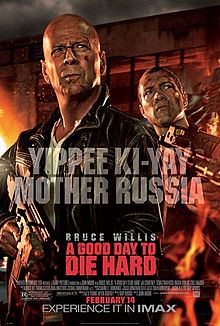
“Why?” you might ask. Well, to put it simply, this is a big
budget action extravaganza like they made in the 1980s. It’s original Die Hard on steroids (another thing we
heard a lot about in the 1980s). And the filmmakers do a good job of reminding
us about the “Decade of Excess” by referencing the year 1986, President Reagan,
Mikhail Gorbachev and having a great deal of the story take place at Chernobyl.
The action starts almost as soon as John McClane (Bruce
Willis) arrives in Moscow and continues without much interruption through to
the climax of the film. A prolonged car chase rips through the Moscow streets
and adds a few interesting twists to the overplayed concept by having McClane
drive his stolen vehicle off a bridge, down a car carrier, over the roofs of
vehicles and across a median to arrive in the proper lane to pursue the bad
guys…if you enjoy stunts, it was pretty cool. Other sequences have McClane and
his son (played by Jai Courtney) dodge countless bullets, fall through numerous
floors and scaffolding, and leap from helicopters to avoid death and bring down
the baddies. They face nuclear radiation head on without wearing protective
suits (not unlike what Indy did when he hid in a fridge during a nuclear blast
in Indiana Jones and the Kingdom of the
Crystal Skull) and come out of it unfazed. Make no mistake…these guys are
superheroes without the capes, cool nicknames or copyright claims of Marvel or
DC Comics.
Now back to the history purist and the fan of realistic
entertainment…A Good Day to Die Hard
gives you a lot to thumb your nose at. Obviously, father and son McClane could
never do in real life what is depicted in “reel life”. And how is it that
average cop John McClane always finds himself in high-stakes contests with
international terrorists? I know a lot of cops and none of them have had a
single run-in with an international terrorist, let alone five run-ins that
involve the kind of weaponry that only the highest brass at the Pentagon know
about. And the film’s account of the 1986 Chernobyl disaster is, of course,
highly inaccurate.
But if you went to the theater and paid your $10 plus to see
A Good Day to Die Hard, you didn’t go
to see realistic scenarios or historical accuracy. You went to watch good
old-fashioned (are the 1980s considered old fashioned?) action. You weren’t
there to be intellectually challenged, you wanted to be visually stimulated by
the biggest explosions and amused by repetitive catch phrases (I forgot to
count how many times John McClane said he was on vacation). Ignoring the latest
weapon gadgetry and the characters’ cell phones, A Good Day to Die Hard is a film that would have fit right in with
1980s cinema. And I for one am glad to see it back on our screens…especially
since audiences seem to have ignored Arnold’s The Last Stand and Stallone’s A
Bullet to the Head.
I loved the 1980s and would like nothing more than to see
the action heroes of yesterday take the place of the comic book heroes of
today. Then again, that’s just me. Are there any other fans of Rad Flicks out
there?
Subscribe to:
Posts (Atom)